Designing and operating superyachts to deal with extreme weather
How is the superyacht industry approaching the challenge of increasingly extreme weather events? Here we bring you a summary of some of the points made from the Navigating Tomorrow’s Waters: Designing for Extreme Weather panel discussion during last year’s edition of The Superyacht Forum
Data suggests that the increase of the temperature of the oceans has affected global weather. Insurance claims due to weather incidents are rising. It is difficult to know if this due to an increase in the number of extreme weather events or an increase in their intensity.
In parallel, customer demand has driven superyachts well away from their more traditional proven forms into a once unimaginable diversity of builds in terms of size, intended operation, facilities and offered experiences. Design features such as beach clubs, large garages with shell openings, reduced negative seals, sailing operations, large open internal spaces without subdivisions, Jacuzzis, large swimming pools and helicopter flight decks are good examples and they all pose their own safety challenges. These features were not anticipated when the international build and stability conventions were drafted. Balancing the desire for the aesthetic and operational convenience and the need for safe design is obviously a significant challenge.
On some designs today opened-up beach club areas are low enough to the waterline that they can have water wash across them just from the wash of a passing jet ski or if the yacht takes on a two to three degrees of list. Even when anchored in less than idle weather, stability and load line of this latest generation of vessels has never been more important.
The superyacht sector is rightly recognising it needs the right strategies in place to ensure the safety of all afloat in the face of these divergent and emerging trends.
Traditional approaches to stability versus modern challenges
There are two long-standing maritime conventions to adhere to when developing superyachts.
The first is the International Convention on Load Lines, dating back to 1966 in its original form, a calculation that defines the minimum freeboard – the distance from the waterline to the deck. The greater the volume of sealed ship you have above the waterline (freeboard), the better the reserve buoyancy in the event of a problem.
Superyachts also must comply with stability criteria. Intact stability addresses the stability performance of the vessel fully closed up and ready for sea. Damage criteria examine how a vessel would behave if taking on water either through being holed or if water can enter through openings in the hull.
Designers predict, and then vessel has an inclining experiment to test, how well the vessel recovers from being displaced from its upright position and how it behaves when doing so. Calculations are based on 1960s studies of cargo vessels. What it doesn't prescribe is the vessel’s dynamic behaviour (how tender or stiff it is when rolling when rolling for example). It doesn’t also consider the influence of stabilisers.
Carriage of a hard printed copy of a Stability Booklet is mandatory for superyachts in most flag states. Its pages contain generic guidance with specific stability information for each vessel.
Focus points when designing for, and managing, stability in modern superyacht designs include:
• Shell doors, beach club doors and the like being placed ever closer to the waterline.
• Large open interior spaces that are brilliant for uninterrupted accommodation arrangements but permit free movement of water, making damage stability harder to achieve.
• Weight control at the build stage and throughout the life of the yacht. Yachts will typically get heavier as they get older through additions and refits, with a risk of shifting the centre of gravity higher. New builds should include growth margins that keep the boat within its planned limits even as those operational additions occur.
• Stability calculations and tests can occur prior to final finishing and commissioning with a superyacht in lightly loaded form, rather than at its typical operational condition.
• The complexity of the Stability Booklet makes it not easy to use for captains and crew; the use of loading computers is a solution (but these are expensive).
• The Stability Booklet is not prescriptive in terms of how to manage specific sea states and headings so captains need to be acutely aware of the limitations of the specific (and often unique) superyacht they command including any potential vulnerabilities it may have. Education programmes from build yards are becoming more commonplace to assist captains and crew with additional knowledge beyond mandatory information.
• Post construction testing of a superyacht reveal its true capabilities. The results of these operational findings should be documented and preserved for future reference.
Evolving codes and human factors
Current construction codes were considered by The Superyacht Forum panel to largely be keeping pace with modern superyacht designs, particularly for motor yachts. For sailing superyachts there was a feeling that some more work is required with how to deal with extreme vertical wind gust events and to fully examine limitations of keel-up operation. It was also observed that there is little point in designing a sailing superyacht with a point of vanishing stability where the mast tip could touch the water and the vessel still recover if down-flooding is a risk and essential hardware aboard cannot cope with operation at extreme angles of heel. Hence manufacturers of superyacht equipment also have an important part to play as well in terms of ensuring their products can cope with unforeseen as well as anticipated demands.
There was universal agreement that superyacht construction codes would need to keep evolving. But also, an acknowledgement that there are finite limits to how far you can push superyacht design and construction to deal with the parallel demands of maintaining safety while creating the ultimate in-touch-with-the-elements experience for all aboard.
Education and communication is key
For that reason, greater customer education and understanding is also critical to keep everyone safe in a future of less predictable and more extreme weather. The industry is necessarily hugely dependant on selling the dream, where every picture of a superyacht features calm waters. Expectation management is not easy to deliver – even if those seeking the experience of high-end yachting of course want to do so safely.
For captains, safety is paramount, but they cannot ignore the demands of owners, guests and charterers who understandably wish their experiences aboard to be everything they visualised prior to buying or booking. Bad weather never features in dreams, and many will have been isolated in day-to-day living ashore from understanding even what an extreme weather event may look or feel like.
Pressure on captain and crew might mean weighing anchor later in the morning to prevent disturbance to guests who are sleeping in, even if bad weather is due. Or deploying of a vessel’s full fleet of tenders, toys and inflatable platforms even when forecasts or local knowledge suggests the likelihood of strengthening wind, hampering the ability to close doors and immediately navigate out of a bay. The increasing congestion of superyacht berths in sheltered harbours and ongoing drive to place customers away from crowds and close to the water leads to more anchoring out and requires yachts to safely ride out bad weather if it strikes.
It’s a similar story for designers and construction yards as they seek to deliver the dream for customers. It is vital to establish with an owner before they sign the contract exactly what they want to use their yacht for. There’s a big difference in the design criteria for someone who wants to just cruise in July and August in calmer waters versus the person who desires to circumnavigate the globe and visit remote waters. Engagement and education must be at the centre of establishing what is appropriate for the design and operation of the yacht, particularly for more vulnerable features like shell doors.
The obvious conclusion is that everyone in the industry has an important part to play in ensuring the safe operation of superyachts in a world of increasingly unpredictable weather. From those enjoying superyachts, to those that create and operate them.
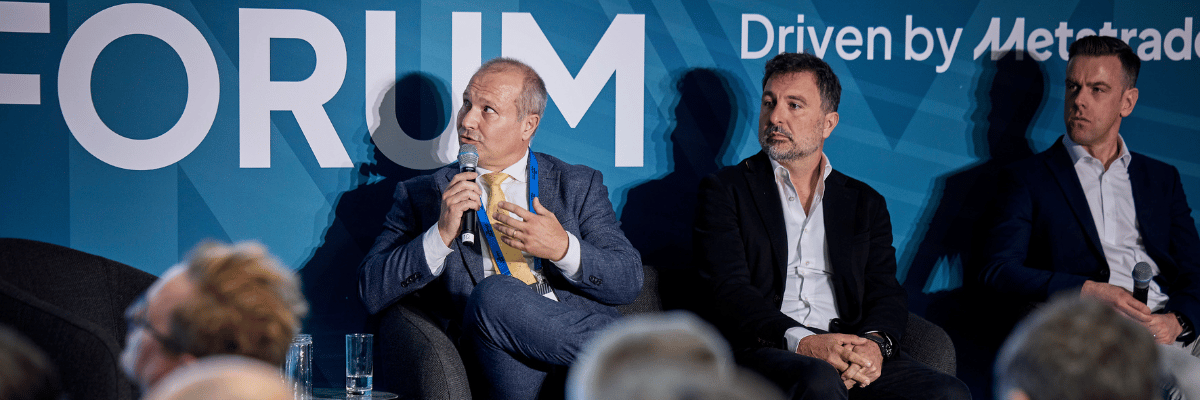
The panel
The Superyacht Forum’s 2025 Navigating Tomorrow’s Waters: Designing for Extreme Weather panel comprised:
Simone Bruckner, Chief R&D Officer at Sanlorenzo. Simone is a mechanical engineer by trade who heads the team supporting the technical office of Sanlorenzo and Blue Game with expertise in production and development.
Andy King, Director of Stability & Statutory at Houlder. Andy is a qualified naval architect with expertise in yacht stability. He teaches stability at UKSA, has been involved with stability plan approvals for a major classification society and involved with stability regulation development over the last few years.
Captain Pietro Giordano is the captain of the Rossinavi 50m superyacht BEL1.
Prior his sea time has been served on yachts in the 45m-60m range and has experience of sailing superyachts.
Peter Southgate, Regional Director Americas for the Cayman Islands Shipping Registry.
Peter has responsibility for the Large Yacht Code development.
The audience was also interactively involved in the discussion through polling and a Q&A.
The Superyacht Forum 2026
The Superyacht Forum will be held this year at RAI Amsterdam from 16-17 November 2026. Please see https://www.thesuperyachtforum.com/ for more details.