As we celebrate 35 years of the DAME Design Awards, this month we consider what lessons two of the smallest overall winners can teach the leisure marine equipment sector today.
The DAME Design Awards was in its seventh year when it announced the smallest and lowest priced overall winner of the competition to-date. The Double Action Safety Hook from Wichard was to prove an exemplar, not only for the yacht safety equipment sector, but also for the DAME Design Awards itself. It is a brilliant benchmark of design in all details that is still referenced today.
Nearly two decades later the mantle of physically smallest and cheapest overall winner passed to Spinlock’s Lume-On lifejacket light, another product demonstrating excellent design principles in a tiny package. We’ll consider the Lume-On further down this article. But first, let’s return to 1997.
Wichard’s Double Action Safety Hook completely reinvented a long-standing solution for enhancing sailors’ safety. Reactions to the winning announcement were mixed – some immediately saw why it had won, others were puzzled: “but it’s just a hook!” Perhaps those less certain of the decision were expecting a DAME winner to be much more complex with cutting edge technology. That view though would be a complete misread of the DAME Design Awards’ steadfast core principle – to encourage improvement through the application of great design of any item of marine equipment – however small, however seemingly simple, however familiar.
To understand why Wichard’s winning entry was so important, consider the norm for deck safety equipment then. Even as the 20th Century reached its final decade, sailors were typically still using tethers and harnesses that were equipped with standard carabiners, a metal hook with a spring opening gate dating back in its original form more than 100 years. These were simple, cheap to produce and familiar. However, they were often not nice to operate, particularly with cold and wet fingers, and required both hands to secure them if they had a screw lock. They could become compromised through breakage if subjected to lateral loads, or inadvertently open if non-locking versions snagged on deck fittings.
Wichard’s Double Action Safety Hook offered one-hand operation with a release mechanism at the rear of the hook, minimising the risk of accidental opening. It brilliantly delivered its objective to improve on current equipment, was strong, easy to use, felt great and looked great. Importantly for a vital item of safety equipment, its form, feel, price point and simplicity of operation encouraged purchase and use.
The DAME Jury, chaired by yacht designer Tony Castro stated: “We were hooked by the hook! The Double Action Safety Hook is a beautifully simple piece of design and engineering. Often the best things in life are the simple ones and for designers and manufacturers the very simple items are often the hardest to make visually attractive and functional. The Jury was not only impressed with the way it does its job, but also by the overall feel, lightweight design and safety features of the product.
It was notable that such a long-standing safety company such as Wichard, founded in 1919, should be the one to completely re-think a decades-old solution that countless sailors had used to remain safe on deck. Sales results since have proven the worth of not being content with status quo.
Speaking at the time of the DAME Design Awards’ 25th anniversary, Wichard’s Eric Butreau reported: “Since launch the Double Action Safety Hook has enjoyed global success among distribution marine networks and prestigious customers involved in safety equipment in the marine and industrial sectors. Winning the DAME gave widespread worldwide exposure, with many magazines publishing articles. Marine retail customers used the award to promote the product in shops, while for Wichard it was welcome recognition of our know-how and concern for sailors’ safety.”
Today the Double Action Safety Hook remains a mainstay in Wichard’s range, as a standalone product and on the company’s range of tethers. Since winning in 1997 the company has received further DAME Design Award accolades including Special Mentions for its Lyf’Safe jackline kit, the Gyb’Easy boom brake and most recently its Offshore Rescue Knife – also all currently in production.
The DAME Design Awards in 2015 was special year. In the closing stages of judgement the Jury remained evenly split between Humphree’s advanced Electric Stabilising Fin & Interceptor System and the tiny radical Lume-On lifejacket light from Spinlock. To specially mark the 25th anniversary of the awards it was decided to name both as overall winners, a perfect illustration of how great design should span products of all types, sizes and levels of complexity. We’ll be looking at the Humphree product in a future article, but the Lume-On, countless times smaller and cheaper, takes our focus here.
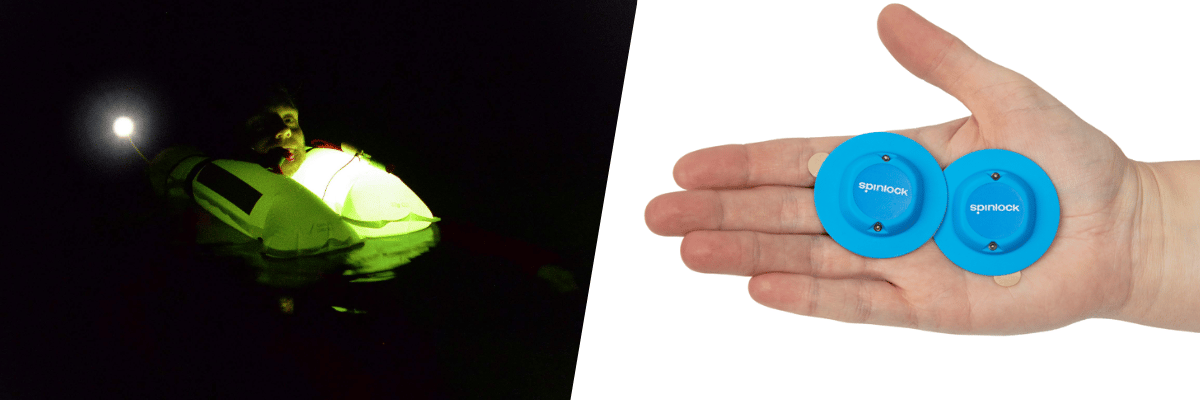
The latter evolved out of an accidental realisation while the Spinlock team was testing another product how brilliantly the high visibility material of a lifejacket bladder glowed when placing a light right beside it. This discovery happily coincided with the rapid pace of development of LED light technology. This enabled Spinlock to place a powerful, miniscule light and a small battery within a stick-on patch so it could be affixed directly to the bladder. Given it already had type-approved lifejacket lights within its range Spinlock decided to develop Lume-On outside of the relevant safety standard as a visibility enhancer rather than a primary light, a decision that brought a pair of Lume-Ons onto chandlery shelves and websites for less than the cost of a round of drinks at the marina bar.
Commenting on the Lume-On the DAME Jury, chaired by yacht designer Bill Dixon, said: “We always welcome the rethinking of everyday items of marine equipment, especially when it leads to enhanced safety at a price point that is affordable by all. The Lume-On’s cleverness of thought, simplicity of application and very accessible cost was widely admired by the Jury. An excellent joint winner of the DAME Awards, perfectly illustrating the value of design in every detail, however small the item.”
This was not Spinlock’s first success in the DAME Design Awards. Back in 1999 it claimed top honours for the PX Cam Cleat, another diminutive product in terms of size and price that packed a lot of clever engineering design into its compact form. The company has also enjoyed several Category wins, Special Mentions and Nomination placements over the years.
Speaking to Metstrade in 2021, Spinlock’s Marketing and Sales Manager James Hall, Marketing and Sales Manager said: “taking part in the DAME Design Awards gives you lots of feedback, whatever level your entry achieves. There’s no arguing though that a win provides a major boost for a product and the benefits come in phases. Short term – the celebration and interest from press, peers and partners at Metstrade. Medium term – ongoing press follow-up and the ability to promote the win within a few weeks at key consumer shows like Düsseldorf and Miami. Long term, Spinlock still references the award years afterwards in its marketing, as it continues to do for Lume-On.”
More than a decade on a simple light that started life as a fortunate observation in a test room has become firmly established, as a standard enhancement to Spinlock’s premium lifejackets and a popular aftermarket sales product where it is sold off the shelf for fitment to any manufacturer’s inflatable lifejackets.
You can read more about the development and testing phase of the Spinlock Lume-On here.
As we have seen with both winning products in this article, just because something is small and inexpensive doesn’t mean it shouldn’t benefit from excellent design in all aspects. There are many long-standing industry norms for routine items of leisure marine equipment but that doesn’t mean they cannot be incrementally improved or even reinvented.
The emergence of new technologies and materials, daring to think differently, looking for inspiration from unexpected sources and then bringing that all together with meticulously detailed design all have their place in making exciting products of the future.
To learn more about the awards, please visit https://www.damedesignawards.com
For this special 35th anniversary year we are publishing a series of features in coming months looking at the winners – who they were, why they won and what they meant within the leisure marine sector.
We would very much like to hear the memories of anyone involved with nominated and winning entries since 1991, particularly the overall winners. If you can help us, then please email dame@rai.nl or contact the author of this series, Kim Hollamby via LinkedIn. He’ll be pleased to get in touch.